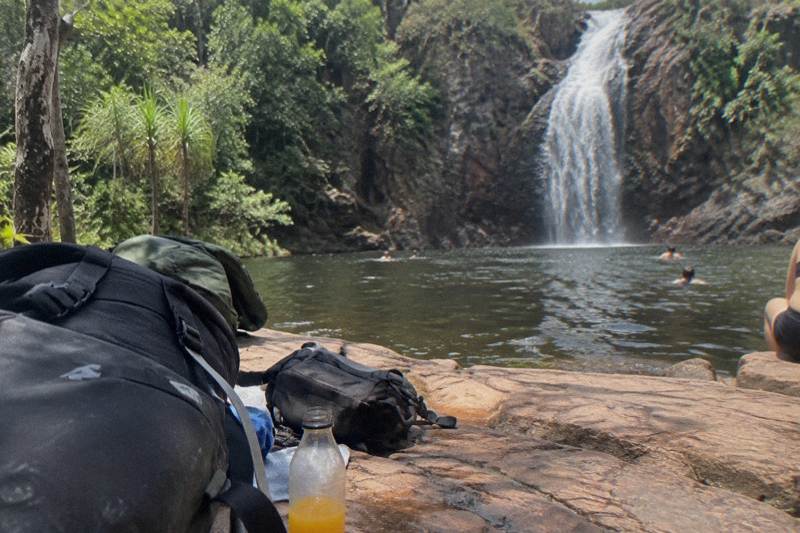
Is It Safe To Swim At Wangi Falls?
Wangi Falls is Litchfield's most accessible swimming hole, and NT Parks manages it with crocodile surveys and seasonal openings. Here is what the official guidance says, and which day tours stop there.
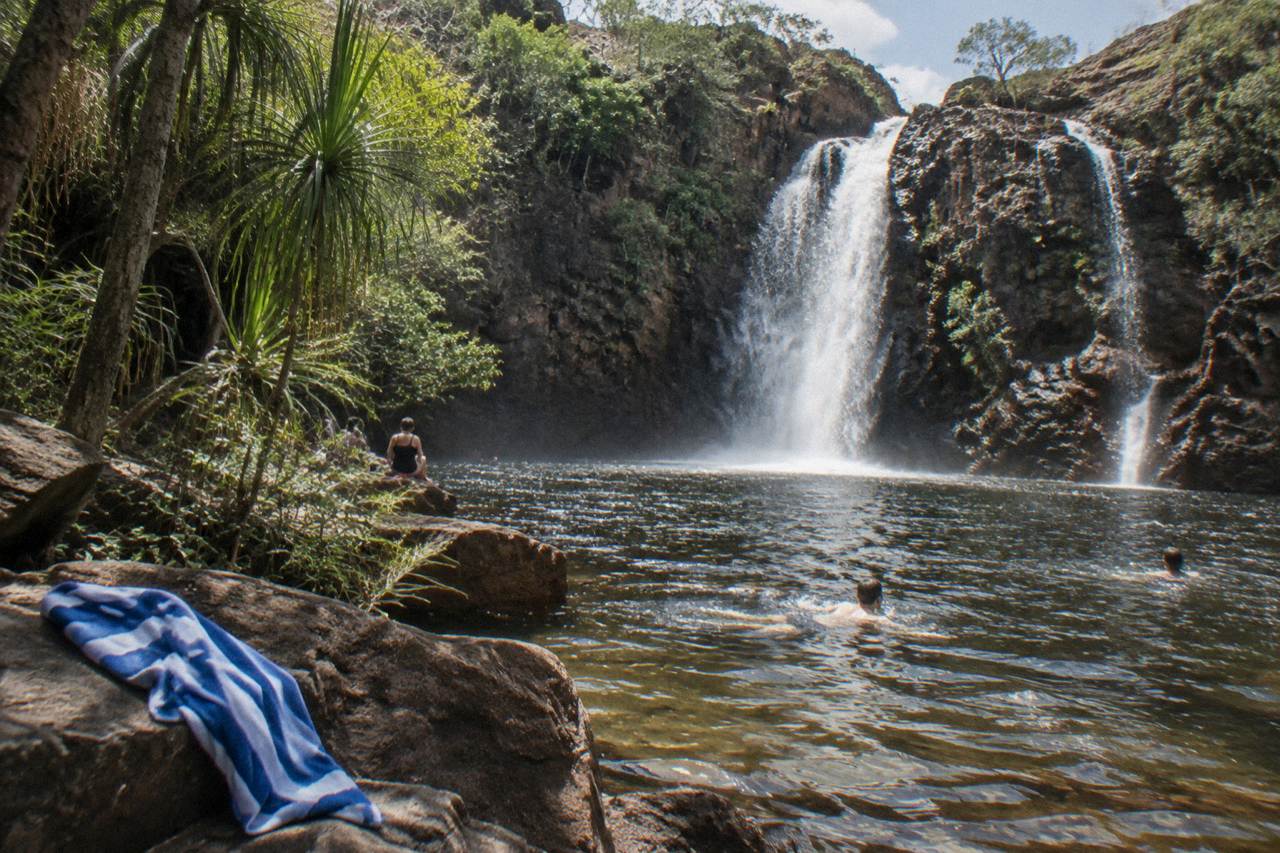
The official seasonality table lists Wangi as dry-season swimming, so access depends on the sign, the season and the surveys. Saltwater crocodiles can be in any Top End waterway, and NT Parks puts it bluntly: "It is never completely safe to enter the water."
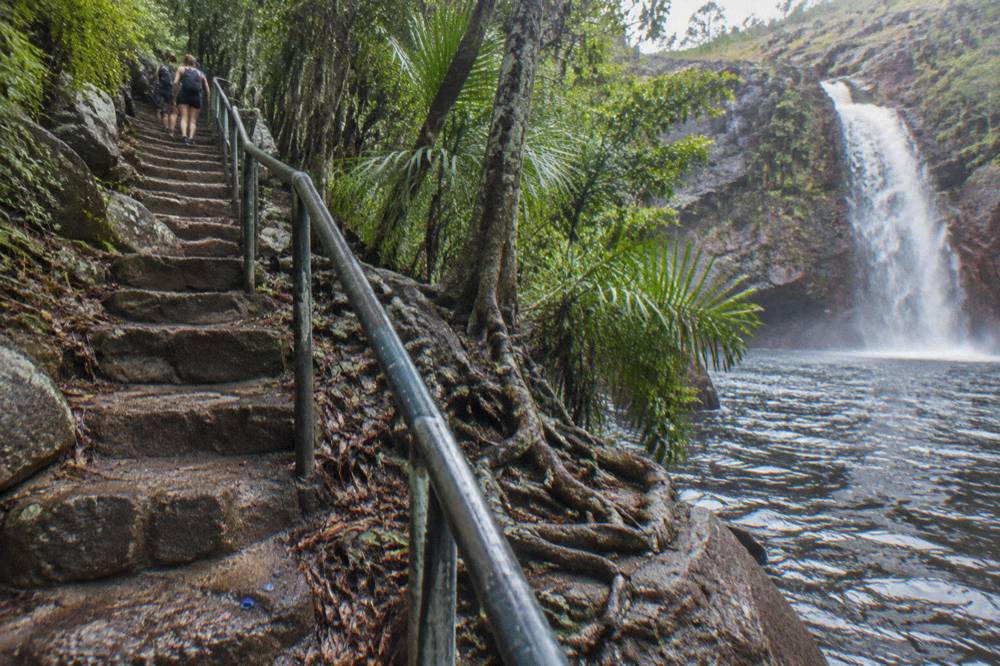
It sits about 120 km south-west of Darwin, reachable through Batchelor or via Cox Peninsula Road, and NT Parks describes it as the most accessible swimming hole in Litchfield: a paved path with a handrail runs from the car park to a large, deep pool where you can swim right up to the falls, which flow all year round. The land itself matters here too. The park is important to the Koongurrukun, Mak Mak Marranunggu, Werat and Warray Aboriginal people, whose ancestral spirits are said to have formed the landscape, plants and animals and are still present in the landscape today.
That accessibility is exactly why the safety question comes up so often. The pool is deep close to shore, and NT Parks warns the water becomes deep quickly. Above the falls there is no swimming at all: the official page states it is not safe to swim at the top of the falls. Below them, swimming is allowed only within the posted swimming area, and only when the sign says open. It is a system built on surveys rather than fences and guarantees, and once you understand that, most of the confusion around Wangi falls away.
The park covers roughly 1,500 km2 of waterfalls, swimming holes, weathered sandstone pillars and the iconic magnetic termite mounds, and Wangi is only one corner of it. But it is the corner with the cafe, the showers and the paved path, which is why the coach tours, the families and the first-time visitors all converge there by late morning. If you arrive with a tour, your guide will read the sign with you; if you arrive with a hire car, the reading is yours to do.
If you are weighing up a guided day rather than driving yourself, three Darwin tours stand out for reaching the waterfalls of Litchfield, Wangi included.
The AAT Kings full-day coach tour with lunch names Wangi Falls, Florence Falls, Tolmer Falls, the magnetic termite mounds and Howard Springs Nature Park in one 10.5-hour day from $151 per person, rated 4.5 across 210 reviews, with Darwin hotel pickup and drop-off and a return to Darwin at about 5.15 pm. The Litchfield Escapes falls-and-crocodile-cruise day covers Wangi Falls, Florence Falls and Buley Rockhole plus an Adelaide River cruise, from $164.87 for roughly 11 hours. Litchfield VIP Tours caps its day at a maximum of 11 guests and adds Berry Springs, from $151 per person. Swimming on any of them remains a seasonal opportunity controlled by NT Parks, not a promise from the operator.
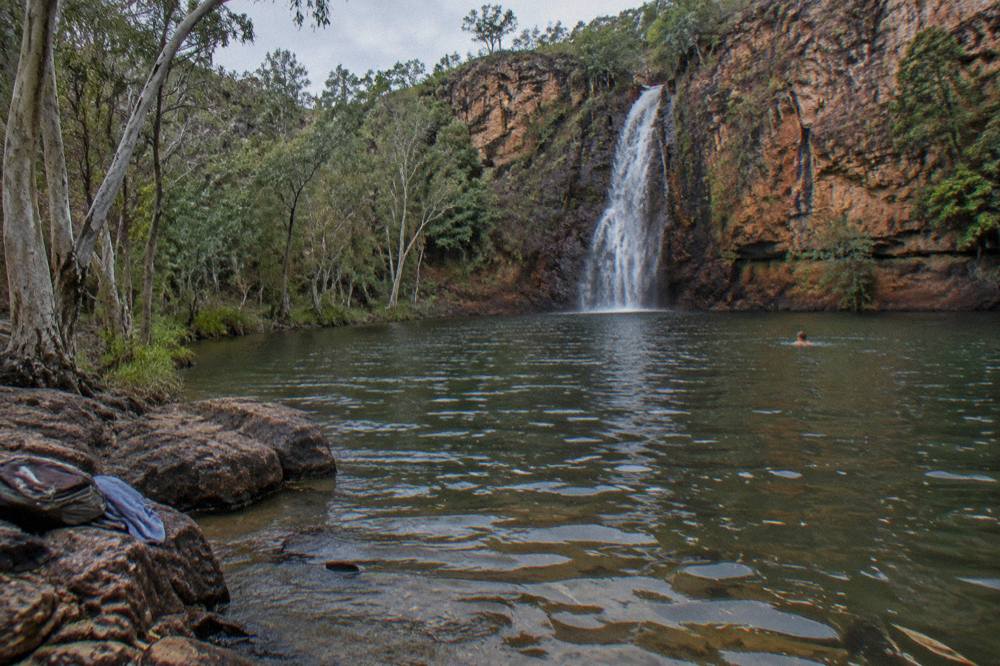
What Do The Official Swimming Rules Say?
The rule is simple and absolute: only swim in an area that has a swimming area open sign, and if it does not have one, do not swim there. NT Parks tests water quality, checks water flow and carries out crocodile surveys at Litchfield's managed swimming spots, including Wangi. The area may not be safe or free from saltwater crocodiles, which is why the sign, not the calendar, is the final word.
The official swimming-in-parks guidance sets out the rest of the water rules, and they apply at Wangi as everywhere in the Top End. Never swim alone. Supervise children at all times. No glass within 10 m of swimming areas. Submerged rocks and logs sit below the surface, and conditions change after floods, so do not jump off any surface, especially waterfalls and rock ledges. The water at Wangi gets deep quickly, which makes the no-jumping rule more than a formality at a plunge pool like this one.
Saltwater crocodiles live in salt and fresh water in the Top End and are dangerous, and the Be Crocwise advice extends the caution beyond the swim itself: camp at least 50 m from the water, never feed or approach a crocodile, and treat every waterway as capable of holding one. None of this means Wangi is dangerous when the sign is up. It means the sign, the surveys and the checks behind them are what stand between you and an unmanaged risk, so you swim inside the posted area and nowhere else.
Read the full rule once and it stops sounding bureaucratic. Parks and Wildlife staff are doing three things before that sign goes up: testing water quality after rain, checking flow rates over the wet months, and surveying for crocodiles. When the sign says open, all three checks have passed for that pool on that day. When it does not, one of them has not, and you have no way of knowing which. That is the entire logic of the system, and it holds from Wangi to Walker Creek.
Because you may be booking rather than driving, it is worth knowing which tours can actually put you at Wangi on a given morning.
When Can You Swim At Wangi Falls?
The official seasonality table lists Wangi Falls as dry season only for swimming, while Florence Falls, Buley Rockhole and the Cascades are listed as all year except during extreme flooding. The wet season, roughly November to April, is when openings can change, so the posted sign and the status page decide.
That combination confuses people, so it is worth being precise about what each part means. The seasonality table is the standing rule: Wangi is a dry-season swimming hole in NT Parks' own classification. Wangi Falls is dry-season swimming only, and Florence Falls, Buley Rockhole and the Cascades are open all year except in extreme flooding; sites can close at short notice, so check the NT Parks status page closer to your travel date. Neither of those facts makes Wangi open all year, and neither makes it closed through the wet months. The sign at the pool is the instruction that outranks both.
| Litchfield swimming spot | Official seasonality table |
|---|---|
| Wangi Falls | Dry season only |
| Florence Falls | All year except during extreme flooding |
| Buley Rockhole | All year except during extreme flooding |
| Cascades (Upper) | All year except during extreme flooding |
| Walker Creek | Dry season only |
| Tolmer Falls | Swimming not allowed |
Parks can also close at short notice due to seasonal conditions such as flooding or bushfires, and NT Parks advises checking Road Report NT before travel. Mobile signal is not available in many areas of the park, so a status checked in Darwin that morning is worth more than one you hope to check at the car park. For a fuller picture of the managed swim spots, the guide to Litchfield swimming holes on a day tour works through each pool.
The status page told a fuller story than the swimming rows alone. Parts of Litchfield may close at short notice due to seasonal conditions such as flooding or bushfires, so check the NT Parks status page close to your travel date. The Lost City sits at the end of a 10 km dirt track that closes completely during the wet season when it becomes impassable. Surprise Creek Falls and its campground close until after the wet, and the Reynolds River track can carry water crossings of 500 to 600 mm. Check the NT Parks status page close to travel dates. Tabletop Track closes in extreme heat, permit access only; check the NT Parks status page. One page, and a park in transition between seasons: that is the normal state of Litchfield in November, and it is why checking beats assuming.
Is The Wangi Falls Pool Dangerous For Children?
Swimming at Wangi is permitted for all ages inside the posted area, but NT Parks warns the water becomes deep quickly and the paved access path includes a few steps, so active supervision is the rule. Children must be supervised near water at all times under the official swimming rules, and the pool's depth near the edge makes that rule load-bearing here rather than boilerplate.
The facilities help. Wangi has showers, toilets, gas barbecues, an emergency call device, free wi-fi, a phone and a cafe with undercover seating, which is why families and coach tours both gravitate to it. The cafe has its own seasonal rhythm worth knowing before you plan lunch around it: the status table notes it closes mid-December 2026 to end of January 2027. Boil-before-drinking water is on site, and the 1.6 km return loop walk, Grade 3 and steep in sections, gives non-swimmers a viewing platform at the base of the falls, monsoon forest and stairs up the escarpment.
For a family day out with a swim at the end, the Litchfield VIP Tours day tour keeps the group to a maximum of 11 guests and lists pool noodles, snacks, tea or coffee and lunch, with the park pass included, from $151 per person, rated 4.8 across 203 reviews, picking up from Darwin accommodation between 8 and 8.15 am and returning about 5.30 pm.
A smaller vehicle is not a safety feature in itself, but on a hot afternoon at a deep pool it means fewer bodies between you and the child you are watching. It also means the pool noodles come out of the vehicle's own kit rather than being hired or forgotten, and the driver knows which end of the pool shelves quickest. None of that replaces the sign or your own eyes, yet on a 33-degree afternoon with a tired seven-year-old, every small advantage counts.
Do Darwin Day Tours Stop At Wangi Falls?
Several do. Tour prices are USD from figures; the NT Parks day pass, A$10 per adult, is extra on the tours that do not include it.
The AAT Kings full-day coach tour charges the park pass separately at A$10 per person for one day, while Litchfield VIP Tours includes the pass in its fare, and the booking page for the Litchfield Park Adventures small-group day says the national park fee is included at its $235 per person rate, so confirm the park fee on the booking page. Litchfield Escapes notes the Litchfield entrance fee is not included and suggests asking about the parks pass when booking. None of this changes the swim; it changes the maths at checkout, which is why the guide to Litchfield entry fees and tour costs is worth a read before you pay.
The pass itself is one national price list, with no interstate or overseas variants: a one-day adult ticket is A$10, a child aged 5 to 17 pays A$5, a family of two adults and four children pays A$25, and a concession ticket is A$8. It is bought online, before you go, through the parks booking system. Longer passes exist if Litchfield is one leg of a bigger Territory trip: three days at A$20, two weeks at A$30, a month at A$45, and an annual pass at A$60 for an adult. Kakadu and Uluru-Kata Tjuta need a separate Parks Australia pass, so a multi-park itinerary means two sets of paperwork.
The crocodile-cruise combination deserves a special mention, because it answers two questions in one day. The Litchfield Escapes Litchfield and Jumping Crocodile Cruise day pairs the waterfalls with an Adelaide River cruise, running about 11 hours for up to 24 guests with a guide, from $164.87, rated 4.9 across 2,249 reviews, meeting at Lizards Bar and Restaurant on Mitchell Street with pickup stated, and listing lunch, snacks and iced water. Minimum age is 4. You swim at Wangi inside the posted area in the dry-season window, then watch saltwater crocodiles from a boat on the Adelaide River, which is the only responsible way to be near them.
Seeing crocodiles fed from the water that same afternoon tends to settle any lingering doubt about why the sign system at Wangi exists. The two halves of that day explain each other.
If you are deciding between Wangi and the other falls on a tight schedule, the piece on doing Litchfield in a day works through the trade-offs.
Can You Swim At The Top Of Wangi Falls?
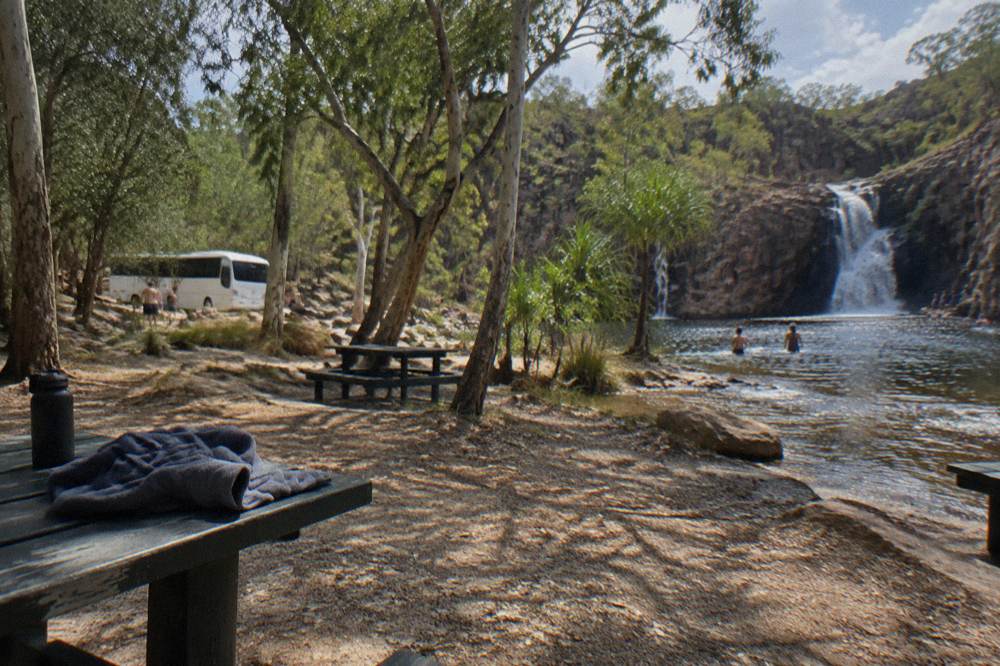
No. NT Parks states plainly that it is not safe to swim at the top of the falls, and swimming is not allowed above the falls at all. The loop walk's stairs reach the escarpment and give views over the top, but the water up there is outside the posted swimming area. The managed swim is in the main plunge pool, right up to the falls, where the sign stands.
It is worth pausing on why the distinction exists, because Wangi rewards understanding its shape. The main pool is large and deep, with the falls pouring into it at one end; that is the surveyed, signed, patrolled swimming area. The top of the falls is a different body of water with different flow, and the official page closes the discussion with a single sentence rather than a list of reasons. Follow it, and keep the same instinct everywhere else in the park: Tolmer Falls allows no swimming, Greenant Creek's plunge pool and downstream area are a sacred site with no swimming, and the Lost City has none either. The rule never changes. Look for the sign, and if there is no swimming area open sign, do not swim.
The same instinct covers the tracks beyond the main stops. Reynolds Track, 44 km and 4WD only, runs between Tolmer and Wangi and reaches Tjaynera Falls, where the 3.4 km return walk leads to a pool you can swim in during its open window; Walker Creek's day-use swimming is likewise permitted unless signed for closure. But no day tour from Darwin covers Tjaynera or Surprise Creek, and none should be booked on the expectation of them. Wangi, Florence and Buley are the swim stops the tours actually serve, and Wangi is the deepest and most developed of the three.
Whether you drive it yourself or take a coach, the pass, the sign and the season do the deciding. This is what Litchfield National Park Tours exists to help you book well.
What Other Swimming Holes Will You See On A Litchfield Day Tour?
A day tour into Litchfield usually pairs Wangi with Florence Falls and Buley Rockhole, both of which the official swimming table lists as open all year except during extreme flooding, and with Tolmer Falls, where swimming is never allowed. That mix means you get a swim where it is signed open and a viewing-platform stop where it is not. Checking how each site is treated in the itinerary tells you how much time you will actually have in the water.
Florence Falls is the strongest swimming partner to Wangi on most itineraries. The pool sits below the falls and can be reached two ways: the Shady Creek track, a 1 km Grade 3 walk with 160 steps taking about 30 minutes each way, or a 1 km monsoon walk on an uneven cobble path with steps. You can also swim in Florence Creek at the top of the falls, and NT Parks notes the falls are at their most spectacular during the wet season and the start of the dry. The same rule applies everywhere: only enter the water where a swimming area open sign is posted.
Buley Rockhole is the other regular stop, a series of shallow and deep holes along flowing water. It has no accessibility ramps, and parking there is limited. When the car park is full, the official advice is to park at Florence Falls and use the Florence Creek walk, a 3.2 km Grade 2 track of about 1.5 hours, to reach Buley on foot. There is no fence between you and the water, so the glass rule matters here: no glass within 10 m of any swimming area.
Tolmer Falls is a different story, and worth knowing before you go. Swimming and camping are not allowed there. The viewing platform is reached on a sealed 400 m path accessible to people of all abilities, and a 1.6 km return loop walk of about 45 minutes runs through the surrounding woodland. Treat Tolmer as a look-and-photograph stop.
Which Tours Give You The Most Water Time?
Several operators build the day around these swimming sites. Litchfield Escapes runs a Litchfield and Jumping Crocodile Cruise combo, about 11 hours, rated 4.9 across 2,249 reviews, from $164.87 per person. Litchfield Park Adventures runs a guided small-group waterfall tour capped at 15 guests, about 10 to 10.5 hours, rated 4.9 across 348 reviews, from $164.87 per person. AAT Kings offers a full-day tour from Darwin with lunch, 10.5 hours, rated 4.5 across 210 reviews, from $151 per person, returning at about 5.15 pm. Ethical Adventures NT caps its premium day at 14 guests, from $199.95 per person, and that one is non-refundable, so check the booking page before you commit.
Wherever you swim in the park, the basics hold: never swim alone, supervise children closely, do not jump off waterfalls or rock ledges, and remember that saltwater crocodiles can be in any Top End waterway, so it is never completely safe to enter the water.
Common Questions About Swimming At Wangi Falls
Is It Safe To Swim At Wangi Falls?
Swimming at Wangi Falls is managed by NT Parks: it is allowed when a swimming area open sign is posted, and the official table lists it as dry-season swimming. Saltwater crocodiles can be in any Top End waterway, so swim only in the posted area.
Is Wangi Falls Closed During The Wet Season?
The official seasonality table lists Wangi as dry-season-only swimming, but NT Parks does not publish a fixed open or closed calendar for the pool. The swimming area open sign and the live status page decide on the day. Parks can also close at short notice due to flooding or bushfires.
Can Children Swim At Wangi Falls?
Yes, inside the posted swimming area and under constant supervision, which the official water rules require for all children. The water becomes deep quickly, and the paved access path includes a few steps, so the pool suits confident swimmers best.
Do Day Tours From Darwin Stop At Wangi Falls?
Plenty of them call in at the falls. AAT Kings charges from $151 per person for its full-day coach tour with lunch, the Litchfield Escapes day combining the falls with a crocodile cruise starts from $164.87, and Litchfield VIP Tours offers a day capped at 11 guests from $151 per person. Swimming remains a seasonal opportunity controlled by NT Parks.
Do You Need To Pay To Swim At Wangi Falls?
Swimming itself carries no extra charge, but visitors to the Northern Territory need an NT Parks Visitor Pass, A$10 for a one-day adult ticket, bought online before you go. NT residents do not need a pass. Some tours include the pass in the fare and some charge it separately, so check the booking page before you book.
Can You Camp At Wangi Falls?
Yes. Wangi Falls has a drive-in campground that takes all vehicles, including caravans, with toilets and showers. Camping costs AUD $15 per adult, $8 per child aged 5 to 17, or $38 per family, on top of the NT Parks Visitor Pass, and sites are booked and paid online before arrival, with no payment at the park. Campground hosts are on site from May to September.